





Gift Card
Sale priceFrom £10.00


Pilla Shooting Glasses
Complete Buyer's Guide
Outlaw X6 · Outlaw X7 · Outlaw X7 Razor | Frames, Lenses & Technology
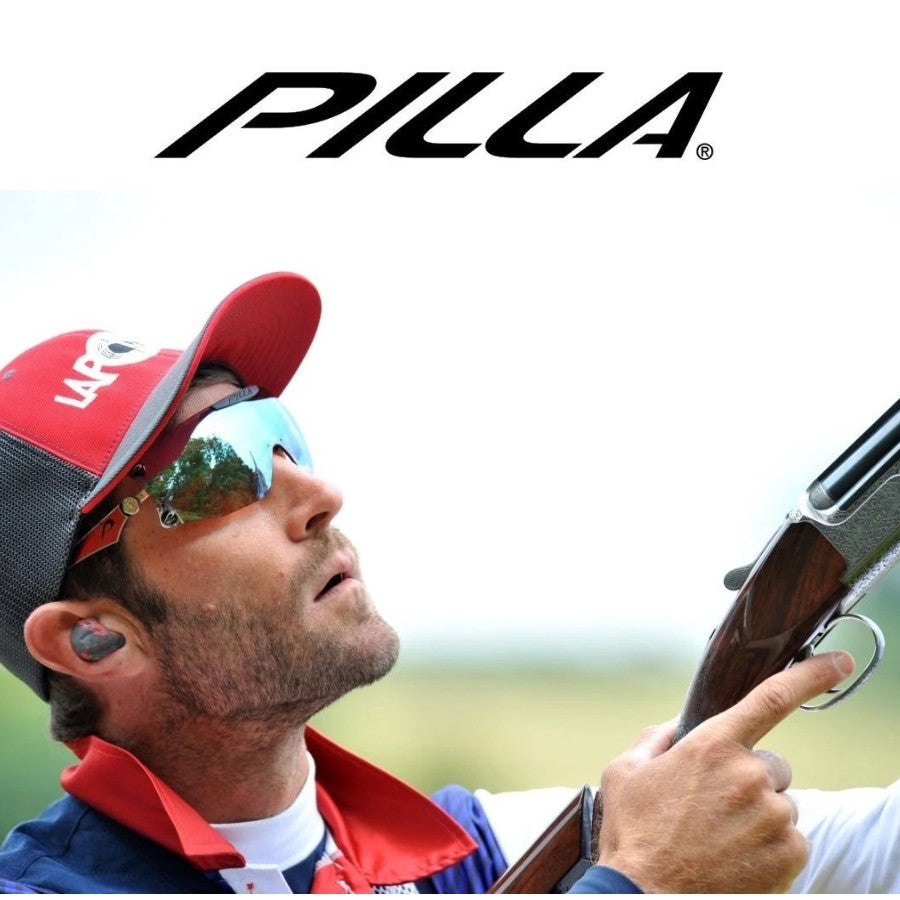
Pilla is widely regarded as the world's most technically advanced shooting eyewear brand. Founded in the United States by Philip Pilla, the company has spent over 25 years redefining sport shooting glasses — working exclusively with Carl Zeiss Vision to engineer lenses that deliver measurable competitive advantages in clarity, contrast, and colour science.
Every Pilla lens is built around three core performance principles: Chromashift colour manipulation, ZEISS precision optics, and the proprietary ICE IR anti-reflective coating system. The result is eyewear trusted by CPSA champions, Team GB shooters, and top clay athletes around the world.
This guide covers everything you need to know about the three Outlaw models — the X6, X7, and X7 Razor — and how to choose the right lens filtrations to suit your shooting conditions, discipline, and face shape.


The Outlaw X6
The X6 is a Base 6 wrap lens — meaning it sits on a flatter curve than the X7, creating a wider, more generous fit across the face. Pilla describe it as medium to large sizing, best suited to:
- People with an average or larger head size
- Shooters who prefer a wider visual field
The X6's flatter profile also means it accommodates a wider range of shooting positions comfortably, and it is the only Outlaw model compatible with Pilla's CGR (Controlled Glare Reduction) lens technology, which requires the specific X6 mould geometry.
The Outlaw X7
The X7 uses a Base 7 high-wrap lens — a tighter, narrower curve that wraps further around the face. This creates more peripheral coverage and a more secure fit. Pilla classify it as small to medium, suited to:
- Those with narrower face features
- Shooters wanting a higher wrap design with greater peripheral protection
The X7 is Pilla's most popular model globally and is available in the widest range of frame configurations, including the exclusive Copa Mundial adjustable hinge system and the Edge Tread temples — lightweight Italian acetate arms designed for refined balance.
The Outlaw X7 Razor
The Razor is essentially a sport-optimised version of the X7. It shares the same Base 7 high-wrap geometry and uses the same X7 temple system, but the lens mask itself has been significantly redesigned for performance and a lower-profile aesthetic:
- The B-measurement (top-to-bottom depth) has been reduced by 12mm
- The top line of the lens is 8mm shorter, allowing comfortable wear under a cap or hat
- A sporty cheek sweep reduces the risk of the lens moving or creeping during gun mount
- The net lens weight is 7/10ths of an ounce — a 12.5% reduction over the X7
The Razor is particularly well suited to shooters who wear a hat, shoot with a deep gun mount, or simply prefer a more streamlined look without compromising on optical performance.
Compare
X6 vs X7 vs X7 Razor — At a Glance
Outlaw X6
Outlaw X7
Outlaw X6 Razor
Lens Curve
Base 6 (flatter)
Base 7 (high wrap)
Base 7 (high wrap)
Best Fit
Medium to large
Small to medium
Small to medium
Lens Depth (B)
Standard
Standard
Reduced by 12mm
Top Line
Standard
Standard
Reduced by 8mm
Weight
Standard
Standard
-12.5% vs X7
Hat Friendly
Yes
Yes
Optimised
CGR Lens Support
Yes
No
No
Copa Hinge Option
Yes
Yes
Yes
Temple Compatibility
X6 Templates
X7 Templates
X7 Templates
FIT TIP: Not sure which model is right for you?
The simplest starting point is face shape and head size. If you have a larger, broader face — go X6. If you have a narrower face — the X7 is likely your better fit. If you wear a cap while shooting or prefer a lighter, lower-profile lens, the Razor is worth serious consideration. Trying the frames in person is always recommended.
Understanding Pilla Lens Technology
Chromashift
Chromashift is Pilla's foundational colour science — integrated into every lens in the sport range. Rather than simply tinting the lens, Chromashift uses specialist colour dyes to manipulate specific bands of the visible light spectrum, producing a more intense colour profile and 'shifting' the apparent colour of the target.
The practical benefit: targets register faster and more distinctly. For clay shooters, this means the orange of the clay becomes more vivid against complex sky and tree backgrounds. For game shooters, it can enhance the separation of a bird from a woodland background.
ICE IR Technology
ICE stands for the multi-layer coating platform that combines hydrophobic and hydrophilic properties with Infra Red (IR) colour enhancement. The ICE coating makes the lens surface extremely slippery — water and oils cannot properly adhere, meaning the lens is highly resistant to fogging and very easy to clean. The IR component amplifies the colour-enhancing performance of Chromashift, creating richer, more vivid sight pictures.
All current Pilla ZEISS lenses carry the ICE IR technology. Lenses produced under the 2024 SPA (Spectral Pigment Acceleration) platform deliver the most advanced version of this science, with in-substrate pigmentation for superior consistency across varying light conditions.
ZEISS Anti-Reflective Coating
Every Pilla lens must meet a stringent ZEISS specification to carry the Zeiss certification. The 7-layer high-performance anti-reflective coating reduces visual noise by 99.9%, cutting glare from the front and back lens surfaces to deliver a crystal-clear sight picture — particularly important when shooting into open sky or against bright, reflective backgrounds.
Chromashift is Pilla's foundational colour science — integrated into every lens in the sport range. Rather than simply tinting the lens, Chromashift uses specialist colour dyes to manipulate specific bands of the visible light spectrum, producing a more intense colour profile and 'shifting' the apparent colour of the target.
The practical benefit: targets register faster and more distinctly. For clay shooters, this means the orange of the clay becomes more vivid against complex sky and tree backgrounds. For game shooters, it can enhance the separation of a bird from a woodland background.
ICE stands for the multi-layer coating platform that combines hydrophobic and hydrophilic properties with Infra Red (IR) colour enhancement. The ICE coating makes the lens surface extremely slippery — water and oils cannot properly adhere, meaning the lens is highly resistant to fogging and very easy to clean. The IR component amplifies the colour-enhancing performance of Chromashift, creating richer, more vivid sight pictures.
All current Pilla ZEISS lenses carry the ICE IR technology. Lenses produced under the 2024 SPA (Spectral Pigment Acceleration) platform deliver the most advanced version of this science, with in-substrate pigmentation for superior consistency across varying light conditions.
Every Pilla lens must meet a stringent ZEISS specification to carry the Zeiss certification. The 7-layer high-performance anti-reflective coating reduces visual noise by 99.9%, cutting glare from the front and back lens surfaces to deliver a crystal-clear sight picture — particularly important when shooting into open sky or against bright, reflective backgrounds.
Lens Filtrations — Finding the Right Filter
Pilla's lens range is built around four key filtration families, each engineered for a different visual outcome. Understanding these families is the most important step in choosing the right lenses for your shooting.
The Four Lens Families
Enhanced Definition (ED)
ED lenses provide a balanced colour lift across the complete visual spectrum. Rather than boosting one specific colour range, they enhance the entire sight picture — making everything sharper, more vivid, and more detailed. In Pilla's own words: 'Everything you see is more vivid.'
ED lenses are ideal for shooters who want a natural-feeling, high-resolution sight picture without exaggerated colour shifts. They are a strong all-round choice across most lighting conditions, and Pilla recommend them for athletes seeking a rich colour profile with a natural reproduction of the visual environment.
High Contrast (HC)
HC lenses use an accelerated filtration curve to produce high levels of saturation, sharpening the edges of targets and creating clear separation between the intended target and its background. Darker elements become darker; lighter elements become brighter — producing the strong contrast registration that is ideal for target shooting where depth of field and edge definition matter.
HC lenses are particularly effective on overcast days, in wooded environments, or wherever the target can be hard to distinguish from a complex background.
Neutralisers (N)
Neutraliser lenses are specialist utility lenses designed to suppress green tones and elevate specific values in the colour spectrum. This makes them highly effective for woodland and game shooting, where dense green backgrounds can make targets difficult to pick out. By suppressing the greens, the target (or bird) stands out more distinctly from its environment.
Max Orange (MO)
Max Orange lenses are engineered to provide up to 600% more boost in the orange part of the visual spectrum. This is a clay-specific technology — designed to maximise the visual registration of orange clay targets, making them dramatically more visible, particularly in bright or hazy conditions.
CGR — Controlled Glare Reduction (X6 Only)
CGR is a specialist lens technology exclusive to the Outlaw X6 that delivers a polarising effect while still enhancing target definition — something standard polarised lenses cannot do. Traditional polarised lenses achieve a 99.9% reduction in reflected light, but this produces a 'muddy' sight picture by stripping out too much light and removing the edge definition needed for accurate target acquisition.
CGR solves this by bleeding a precisely regulated percentage of reflected light back into the sight picture — enough to retain edge sharpness and target definition, while still dramatically reducing glare. This makes CGR ideal for shooting in water-side environments, on bright winter days with low sun, or in any condition where glare is a significant factor.
Pilla and ZEISS also developed a red/green colour deficiency variant within the CGR platform — a dedicated lens for shooters who struggle to distinguish orange clays against backgrounds. This took over 24 months to perfect.
Understanding Light Transmittance
Each Pilla lens carries a number indicating its light transmittance value — the percentage of light that passes through the lens. The higher the number, the lighter the lens; the lower the number, the darker.
| Transmittance Range | Lighting Condition | Typical Use |
|---|---|---|
| High (e.g. 70%+) | Low light / overcast / indoors | Dawn, dusk, woodland, indoor ranges |
| Medium (e.g. 30–60%) | Variable / mixed light | Changeable British weather, most clay grounds |
| Low (e.g. 10–25%) | Full sun / bright conditions | Summer competition days, high glare environments |
Pilla note that darker lenses (lower transmittance) carry more pigment tuning technology — so if you want the most dramatic colour shift effect, darker lenses deliver more demonstrable 'lift'. Lighter lenses are better suited to low-light conditions where brightness is needed.
Eye Colour & Lens Choice
Pilla note that eye colour has a practical effect on lens selection. Lighter-coloured eyes tend to be more light sensitive — making lower transmittance (darker) lenses more comfortable. Darker eyes are typically less light sensitive and may benefit from slightly higher transmittance values, allowing a touch more light through the lens.
Progressive Filtrations
In addition to the solid colour filtrations, Pilla offer Progressive lenses — dual-zone lenses that combine two different filtration values within a single lens, transitioning from a darker zone at the top (typically for overhead targets and sky) to a lighter zone lower in the lens. This is particularly useful for shooters who face rapidly changing target backgrounds — for example, a driven bird against bright sky that then drops below the treeline.
Lens Selector
Which Lenses for Which Conditions?
Use this quick reference to guide your starting lens selection based on your shooting environment and conditions.
Shooting Environment
Recommended Family
Notes
Bright sun / summer competition
ED or HC (low transmittance)
Reduce glare; max target definition
Overcast / flat grey light
HC or ED (medium transmittance)
Boost contrast to compensate for dull conditions
Woodland / game shooting
N (Neutraliser)
Suppress greens, isolate the target from background
Orange clay targets — any light
Max Orange (MO)
Up to 600% orange boost for maximum clay visibility
Bright / glare-heavy (X6 users)
CGR
Polarising effect with retained definition — X6 only
Varying light / changeable day
Progressive filtration
Dual-zone for adapting to sky and ground
Low light / dawn / dusk / indoors
ED or HC (high transmittance)
Maximise available light while retaining definition
Red/Green colour deficiency
CGR Colour Deficiency lens
Specialist lens — X6 only, 24 months in development
How many lenses do I need?
Pilla's system is designed around interchangeable lenses — the snap-tech temple system allows lenses to be changed in seconds. Most serious shooters carry a minimum of three to four lenses covering: bright conditions, overcast conditions, and a low-light option. Pilla offer kit discounts when purchasing multiple lenses together, making it cost-effective to build a complete set from the outset.
Prescription Options
Pilla offer two approaches for shooters who require vision correction:
Rx Insert (Recommended for Outlaw / Razor)
The Outlaw and Razor systems accommodate a prescription insert that sits behind the outer lens mask. The insert is held by the exterior mask at the left and right edges. Pilla can fill the prescription in the insert directly, or it can be glazed locally. The insert supports single-vision, bifocal (flat-top), progressive, and hi-index options.
Traditional Prescriptive Glasses
Pilla also produce traditional prescriptive shooting glasses where the prescription is ground directly into the shooting lens. This avoids the insert entirely but limits the flexibility of lens changes.
Rx Insert (Recommended for Outlaw / Razor)
The Outlaw and Razor systems accommodate a prescription insert that sits behind the outer lens mask. The insert is held by the exterior mask at the left and right edges. Pilla can fill the prescription in the insert directly, or it can be glazed locally. The insert supports single-vision, bifocal (flat-top), progressive, and hi-index options.
Traditional Prescriptive Glasses
Pilla also produce traditional prescriptive shooting glasses where the prescription is ground directly into the shooting lens. This avoids the insert entirely but limits the flexibility of lens changes.
Building Your Kit
1. Start with the Frame
The most important first decision is the frame. Get the fit right before thinking about lenses. If possible, try the X6 and X7 in person — the difference in wrap and face coverage is immediately apparent when worn.
2. Choose Your Core Lenses
For a practical all-weather starter set for clay shooting, most shooters benefit from:
- A medium-transmittance ED or HC lens for overcast and variable conditions (the most-used lens for most British shooters)
- A low-transmittance ED or MO lens for bright, sunny days
- A higher-transmittance lens for low-light conditions, woodland, or indoor ranges
3. Add Specialist Lenses as Needed
Once the core set is established, Neutralisers and CGR (X6) or Progressive lenses are excellent additions for game shooting, driven shooting, or conditions with significant glare. The Eye Dominance lens kits — available in X6, X7, and X7 Razor — are a relatively new addition to the range, offering a solution for shooters with cross-dominance issues as an alternative to patches or opaque lenses.
4. Kit Discounts
Pilla price lenses individually at around $349 per lens (£ equivalent varies by retailer). Purchasing multiple lenses as part of a custom kit attracts a discount — the more lenses in the kit, the greater the saving. If you're planning to build a set of three or more lenses, always build the kit at the point of first purchase rather than buying lenses individually over time.
This guide has been compiled using content from Pilla's own product descriptions, filtration technology pages, and FAQ documentation at pillasport.com. It is intended as a reference for shooters and retailers to understand the product range and make confident, informed choices. For the most current lens filtration codes, pricing, and availability, always refer to the Pilla website or your authorised Pilla dealer.